
Clinical Decision Support: Drug-Allergy Safety Checking
The Scope of the Problem
Adverse Drug Events (ADEs) are a significant cause of patient harm. According to the World Health Organization:
- 1 in 10 hospitalized patients experiences an adverse drug event
- Up to 50% of ADEs are preventable
- Drug allergies are among the most common causes of ADEs
Many of these events occur because clinicians are unaware of a patient’s allergies at the time of prescribing.
NileByteCare’s CDSS Solution
NileByteCare includes a sophisticated Clinical Decision Support System (CDSS) that checks every prescription against the patient’s allergy profile before the medication is dispensed.
How It Works
-
Allergy Documentation — Patient allergies are recorded during registration and updated at each encounter. Each allergy includes:
- Allergen group (e.g., Penicillins, Sulfa, NSAIDs)
- Severity (Mild, Moderate, Severe, Anaphylaxis)
- Reaction description
-
Medication-Allergen Mapping — Each medication in the catalog is mapped to relevant allergen groups. For example, Amoxicillin is mapped to the Penicillins group.
-
Real-Time Checking — When a clinician prescribes a medication, the CDSS engine:
- Identifies the medication’s allergen groups
- Cross-references with the patient’s known allergies
- Returns a safety result
Safety Result Levels
| Level | Meaning | Action |
|---|---|---|
| Safe | No allergy conflict | Prescription proceeds normally |
| Warn | Possible cross-reactivity | Warning displayed, clinician can override |
| Block | Confirmed allergy match | Prescription blocked unless clinician overrides with justification |
Beyond Allergies
The CDSS engine is extensible and can support additional checks:
- Drug-drug interaction checking
- Duplicate therapy warnings
- Dose range checking (pediatric, geriatric)
- Renal/hepatic function-based dosing
Managing Allergen Groups
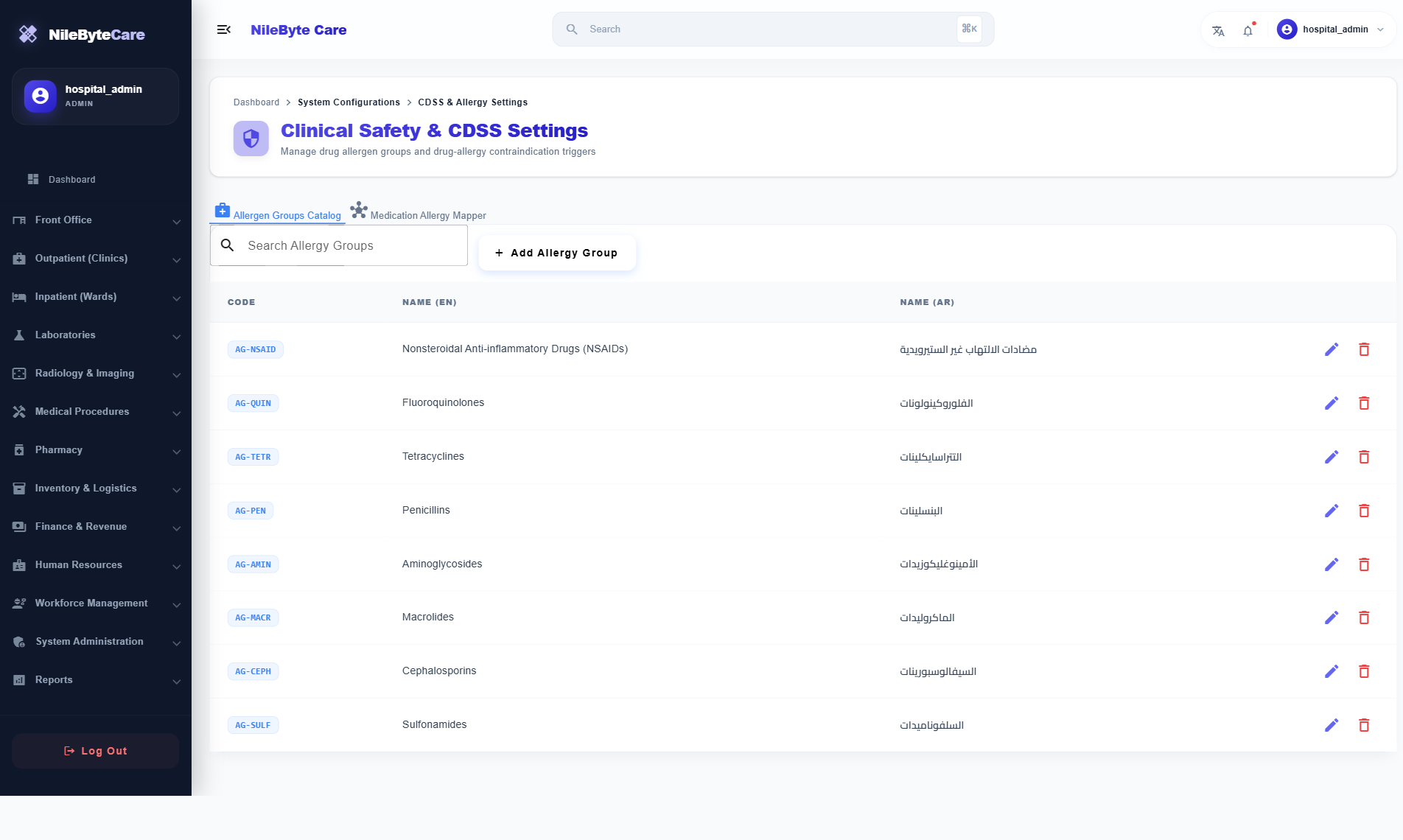
System administrators can manage allergen groups:
- Add new allergen groups (e.g., Penicillins, Sulfonamides, NSAIDs, Opioids)
- Map medications to allergen groups
- Configure severity thresholds
- Integration with external drug databases (RxNav/NIH)
The Impact
With NileByteCare’s CDSS:
- Zero preventable adverse drug events from known allergies
- Clinician confidence — Every prescription is verified
- Patient trust — Knowing allergies are checked gives peace of mind
- Compliance — Meets patient safety standards and accreditation requirements
Real-World Case
A patient with a documented severe Penicillin allergy presents with an infection. The clinician selects Amoxicillin. NileByteCare’s CDSS immediately displays a Block alert:
“This medication (Amoxicillin) is contraindicated due to patient’s Penicillin allergy (Severe - Anaphylaxis).”
The clinician selects an alternative antibiotic. A potentially life-threatening reaction is prevented.
Patient safety is non-negotiable. NileByteCare’s CDSS helps you deliver safer care.
Author at NileByte — sharing insights on software and digital transformation.
Related Articles

Real-Time Notifications: Stay Informed Across Your Healthcare Facility
NileByteCare's real-time notification system keeps clinicians, nurses, lab technicians, and administrators informed with instant alerts delivered via SignalR.

Treatment Plans: Structured Care Pathways for Chronic Disease Management
NileByteCare's treatment plan module enables structured, multi-session care pathways for chronic disease management, physiotherapy, rehabilitation, and more.

Security and Access Control: Enterprise-Grade RBAC
NileByteCare's role-based access control ensures every user sees only what they need. Granular permissions, audit trails, and LDAP integration provide enterprise-grade security.