
The Revenue Cycle in Healthcare
The healthcare revenue cycle is complex. Services are delivered, charges must be captured, insurance portions calculated, payments collected, and accounts reconciled. Each step is an opportunity for revenue leakage.
NileByteCare’s comprehensive finance module manages the entire cycle.
Revenue Cycle Stages
1. Service Capture
Every clinical service is automatically captured for billing:
| Service Type | Auto-Capture Point |
|---|---|
| Consultation | Encounter created |
| Lab Test | Lab order placed |
| Imaging | Imaging order placed |
| Procedure | Procedure performed |
| Medication | Medication dispensed |
| Inpatient Stay | Per diem room charges |
| Nursing Services | Nursing round completed |
2. Unbilled Items
All captured services appear in the unbilled items queue:
- Items awaiting invoice generation
- Group by patient or encounter
- Review and adjust before billing
- Ensure nothing is missed
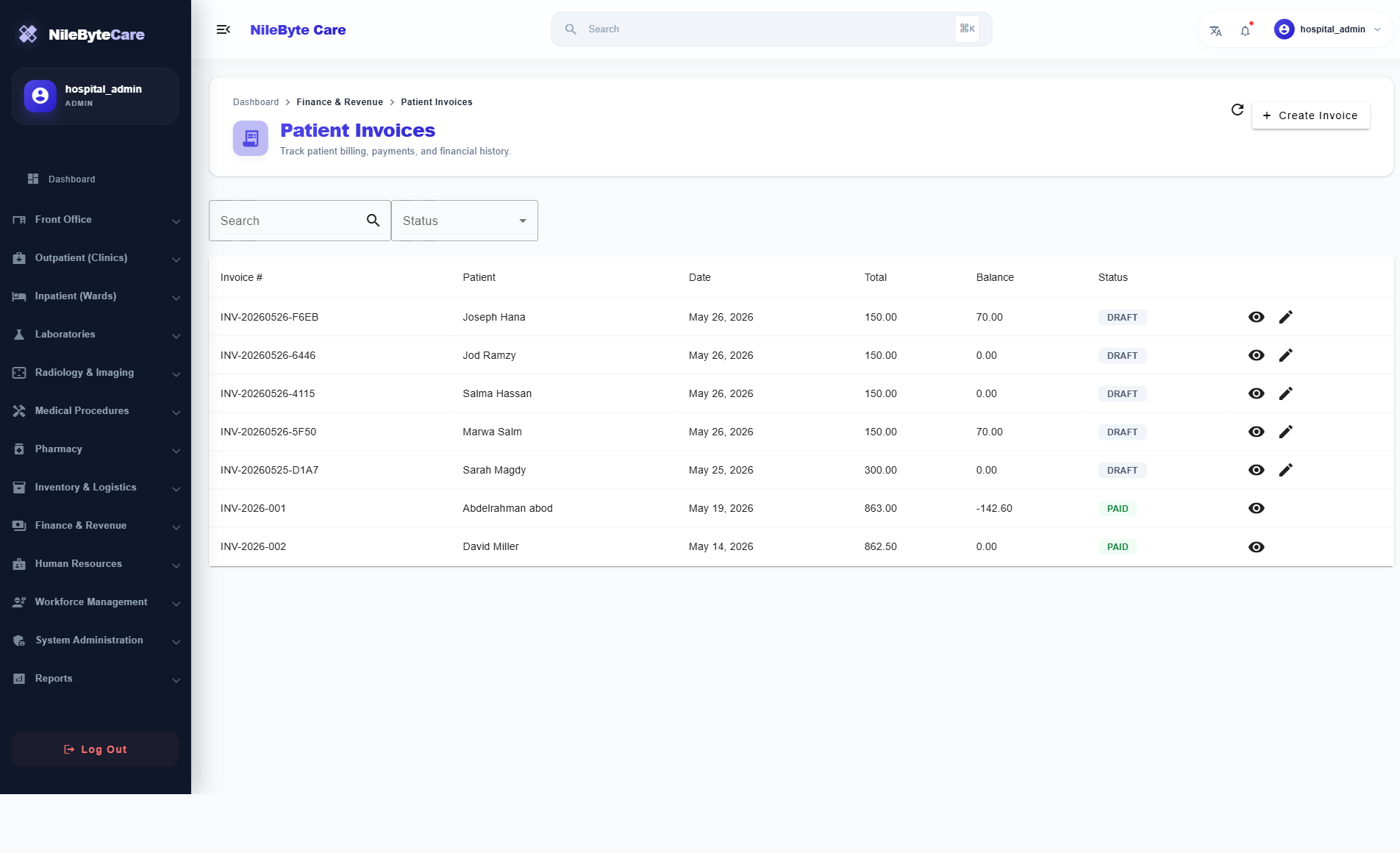
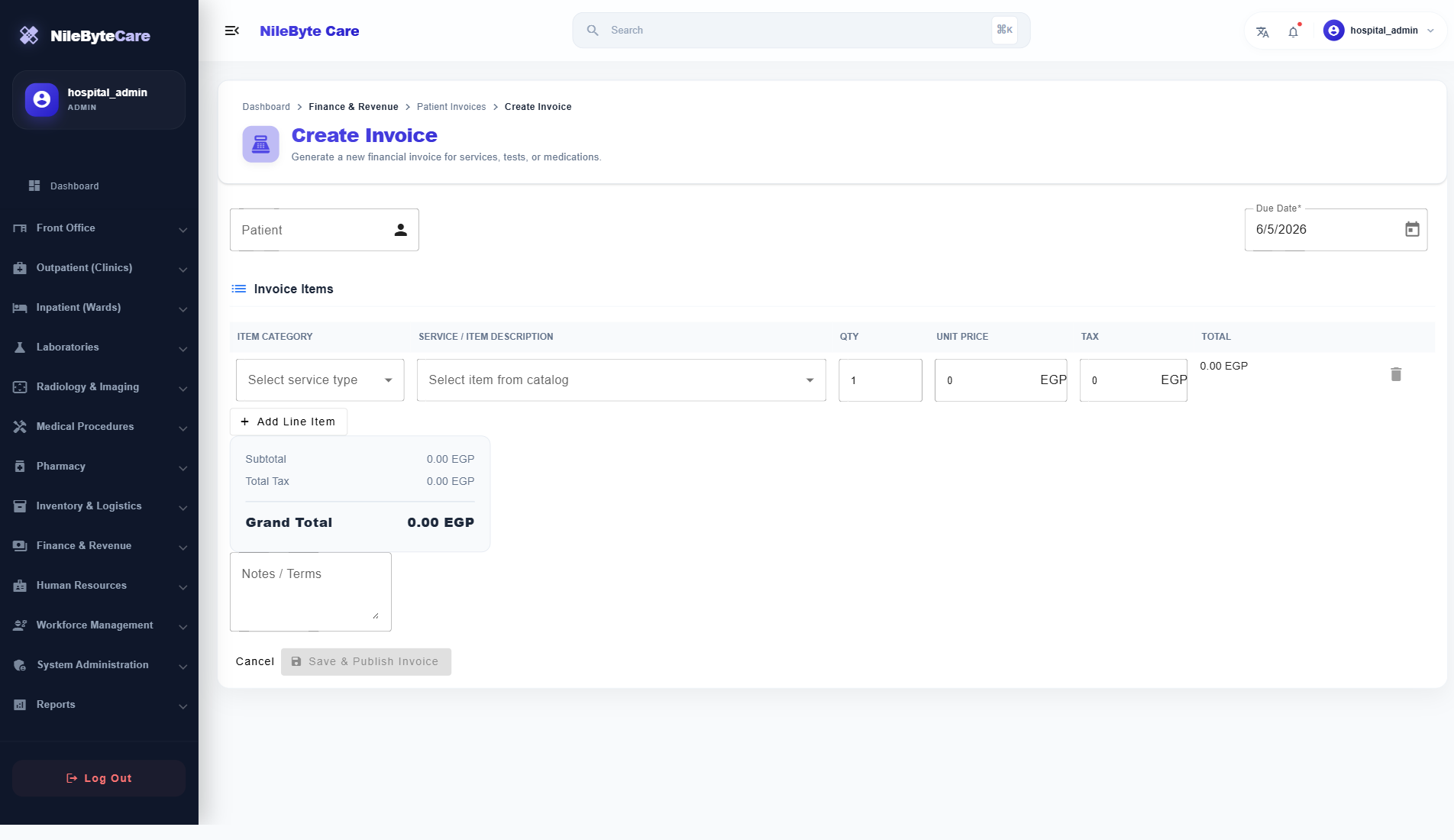
3. Invoice Generation
Invoices are created with insurance split calculation:
- Patient’s insurance policy applied
- Coverage percentage calculated
- Patient portion vs. insurance portion clearly shown
- ETA-compliant format with QR code
- Status: Draft → Published
4. Insurance Claims
For insured patients, claims are automatically generated:
- Claim drafted from invoice data
- Service-specific coverage rules applied
- Prior authorization checked
- Submitted electronically to clearinghouse
- Status tracked: Draft → Submitted → Approved/Rejected
5. Payment Collection
Multiple payment methods supported:
| Method | Description |
|---|---|
| Cash | Direct cash payment |
| Credit Card | Card payment at counter |
| Bank Transfer | Direct bank deposit |
| Insurance | Portion covered by insurance |
| Online Payment | Patient portal payment (Paymob/2Checkout) |
6. Journal Entries
All financial transactions are posted to the general ledger:
- Automatic double-entry posting
- Configurable chart of accounts
- Cost center allocation
- Trial balance in real-time
Key Financial Features
Chart of Accounts
Hierarchical account structure:
- Assets (Cash, Receivables, Inventory)
- Liabilities (Payables, Accruals)
- Equity (Retained Earnings)
- Income (Consultation, Lab, Pharmacy Revenue)
- Expenses (Salaries, Supplies, Utilities)
Cost Centers
Track profitability by department:
- Each operating unit can be a cost center
- Revenue and expenses allocated
- Department-level P&L reporting
Credit Notes
- Issue credit notes for adjustments
- Apply to existing invoices
- Track refunds
Vendor Management
- Vendor registration and tracking
- Vendor bills and payments
- Accounts payable aging
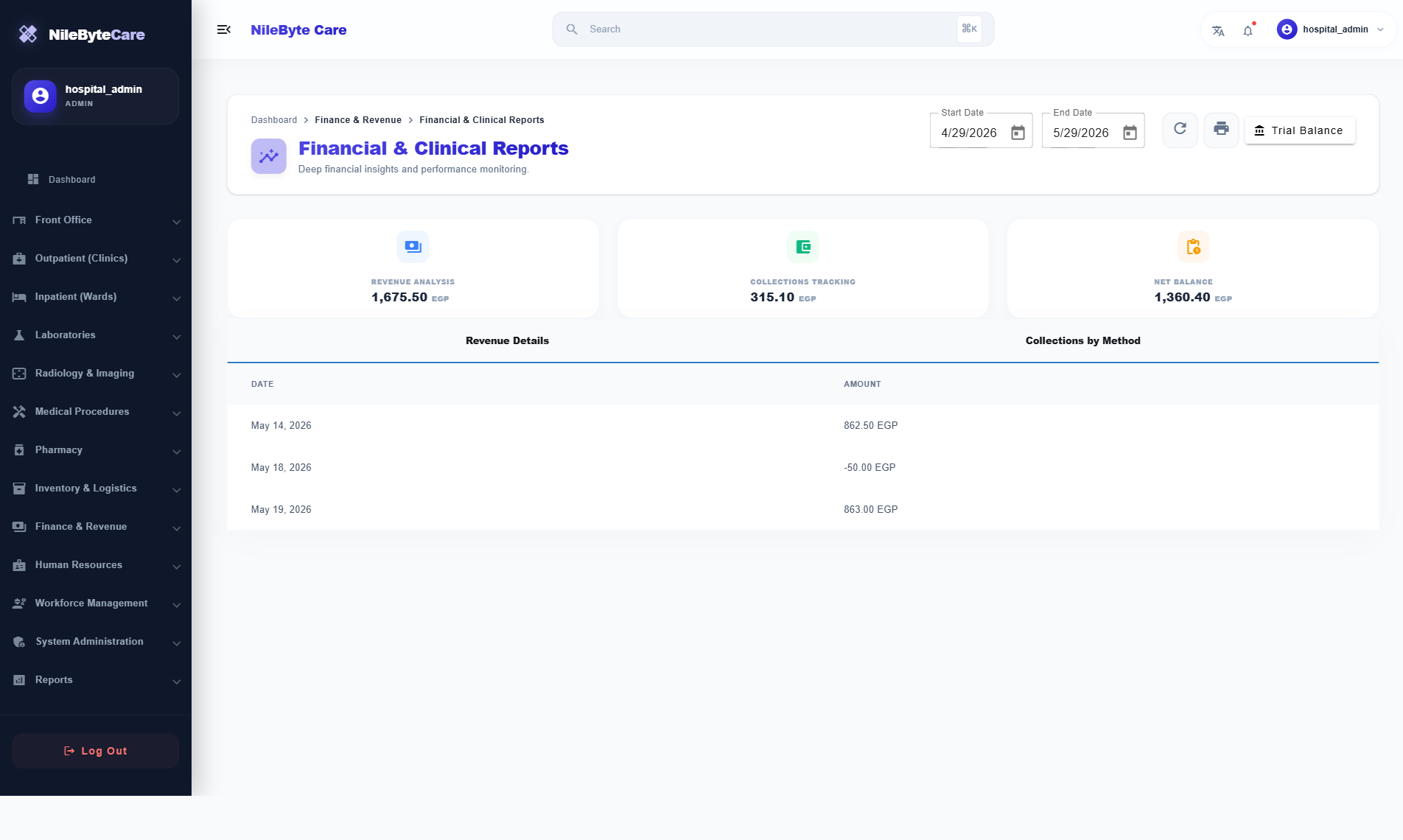
Financial Reports
| Report | Purpose |
|---|---|
| Daily Revenue | Current day’s revenue by type |
| Monthly Revenue | Monthly trends and comparisons |
| Trial Balance | Debit/credit balances by account |
| Income Statement | Revenue vs expenses |
| Accounts Receivable | Outstanding patient balances |
| Collection Report | Payments by method |
| Revenue by Department | Department-level performance |
The NileByteCare Difference
- Zero missed charges — Automatic service capture
- Faster payments — Online payment portal and QR codes
- Insurance optimization — Automated claims reduce rejections
- Financial control — Real-time visibility into revenue and expenses
- Regulatory compliance — ETA-compliant invoicing
Maximize your revenue cycle with NileByteCare.
Author at NileByte — sharing insights on software and digital transformation.
Related Articles

Real-Time Notifications: Stay Informed Across Your Healthcare Facility
NileByteCare's real-time notification system keeps clinicians, nurses, lab technicians, and administrators informed with instant alerts delivered via SignalR.

Treatment Plans: Structured Care Pathways for Chronic Disease Management
NileByteCare's treatment plan module enables structured, multi-session care pathways for chronic disease management, physiotherapy, rehabilitation, and more.

Security and Access Control: Enterprise-Grade RBAC
NileByteCare's role-based access control ensures every user sees only what they need. Granular permissions, audit trails, and LDAP integration provide enterprise-grade security.